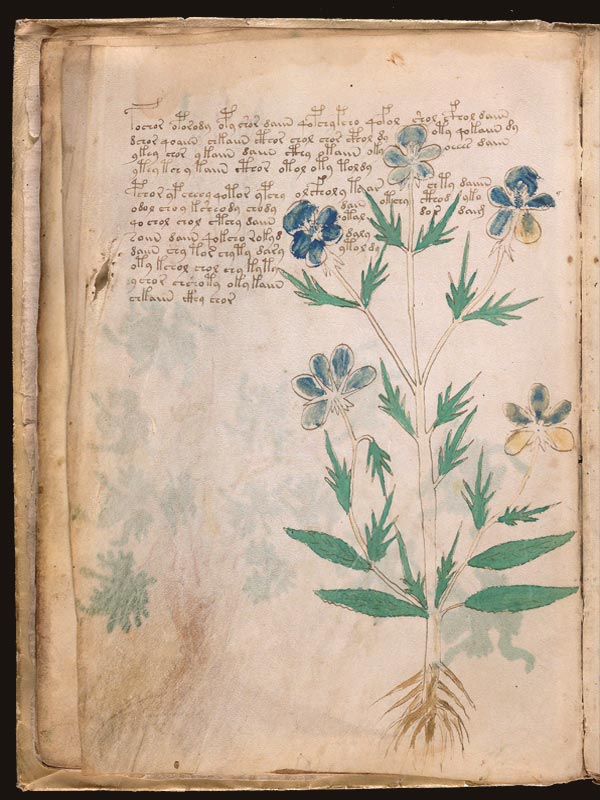
Wild pansy (Viola tricolor)(f9v)
For pain proceeding from an inherent weakness, this remedy is found to be of benefit when prepared in the form of an electuary; likewise, there are preparations made with wild pansy that are useful for sterility, being a thing most beneficial for the womb. It serves to ease uterine pain and inflammations, employing the more succulent part of the plant, which is prepared either bruised or boiled, and then set to infuse in honey or syrup, and afterward administered to be chewed. It may also be pounded and applied in the manner of a plaster upon the affected part. As for the plant itself, its flowers show a calyx opening in this fashion; they are covered with a slight down, and their veins are filled with fibres resembling hemp; the leaves, somewhat viscous, are divided and contain a mucilaginous substance; its grains, like small grapes, enclose a thick and gummy matter; and the fruits, as well as the leaves and roots, are of a soft consistency.
This remedy is held to be useful in the pains proper to the menstrual course and in inflammations of the womb; the plant is prepared bruised and applied, chiefly making use of the flower. It is not an affection caused by a blow, but rather internal; for its preparation the flowers are boiled and set in order within the compound, gently or in a suitable liquor. When the process is complete, the maceration is left to rest and is then applied upon the belly, after being well reduced. The substance obtained by pressing works effectively, the root being especially serviceable. There is also made a compound which is kneaded and spread in layers, being moistened, and which profits in deep-seated ailments when mixed with honey. It may likewise be taken little by little, being allowed to dissolve in the mouth. The leaves are to be gathered when they are well grown and open, in warm weather and at their full development. The flower presents its petals disposed in such a manner that they encircle one another in the fashion of rings, and the fruit is likewise of good use. The whole plant keeps due proportion in its form, the leaves and petals corresponding one to another, and showing within a firm and well-ordered structure. The leaves are broad and, when applied with heat, soften readily.
[Complete translation]
The plant illustrations in this manuscript do not necessarily represent the exact morphology of the identified species, but rather highlight the parts of medicinal interest and their therapeutic uses. The shapes and arrangements are stylized conventions typical of medieval manuscript tradition.
The translation presented here, with the scope indicated on the homepage, is a derivative work protected by copyright. If you use this material, you must cite the translator (Enrique Menéndez Crespo, 2025) and the original source: https://www.voynichdoc.com