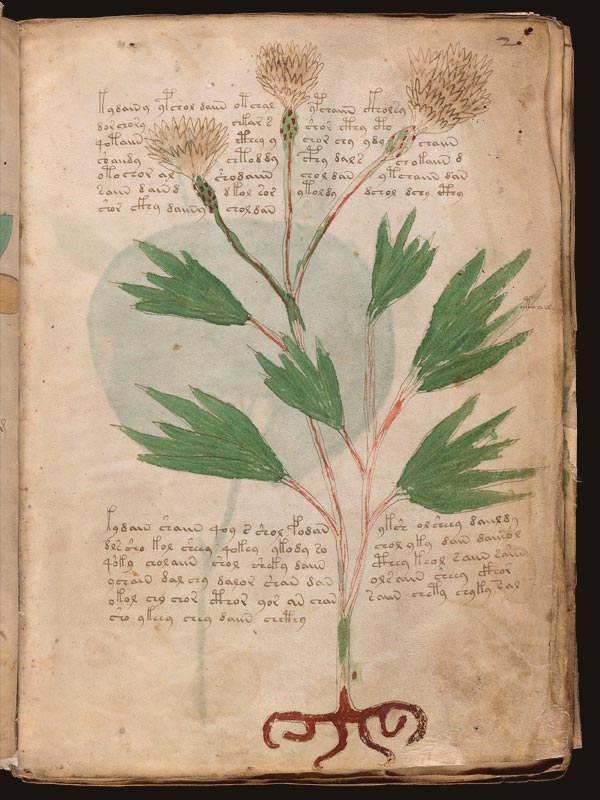
Alexandrian senna (Senna alexandrina) (f2r)
The leaves of senna, used in the preparation of a laxative, must be carefully gathered and processed until thoroughly crushed. Once the appropriate decoction has been made, the substance is thickened into a medicinal paste, which is then further pounded until it reaches a uniform consistency.
From this mass, small portions or pellets are formed and compacted so that they retain their strength and remain cohesive without losing their properties. The preparation should be kneaded repeatedly until it softens and its medicinal virtue is fully manifested.
Thus prepared, the remedy is evenly blended in all its parts and preserves its properties when stored without excess moisture. After proper work in the mortar, an effective purgative preparation is obtained. Finally, the resulting substance is kneaded again with what remains from the decoction and left to rest in separate portions until its medicinal preparation is complete.
The leaves are first worked until they thicken and are reduced to a compact paste, which is used as a medicine against pain associated with constipation. When prepared by grinding or infusion, they produce notable benefit when properly administered.
The leaves may also be macerated to obtain a concentrated extract. The mixture should be gently worked by hand, ensuring that it remains soft and does not spoil during preparation or after the completion of the decoction.
The fruits of the plant help relieve heaviness of the stomach and promote evacuation, while the galls added together with the leaves moderate the purgative action of the remedy. Once all the components are combined and thoroughly ground, the medicine is completed by forming small medicinal pellets ready for use.
[Complete Translation]
The plant illustrations in this manuscript do not necessarily represent the exact morphology of the identified species, but rather highlight the parts of medicinal interest and their therapeutic uses. The shapes and arrangements are stylized conventions typical of medieval manuscript tradition.
The translation presented here, with the scope indicated on the homepage, is a derivative work protected by copyright. If you use this material, you must cite the translator (Enrique Menéndez Crespo, 2025) and the original source: https://www.voynichdoc.com