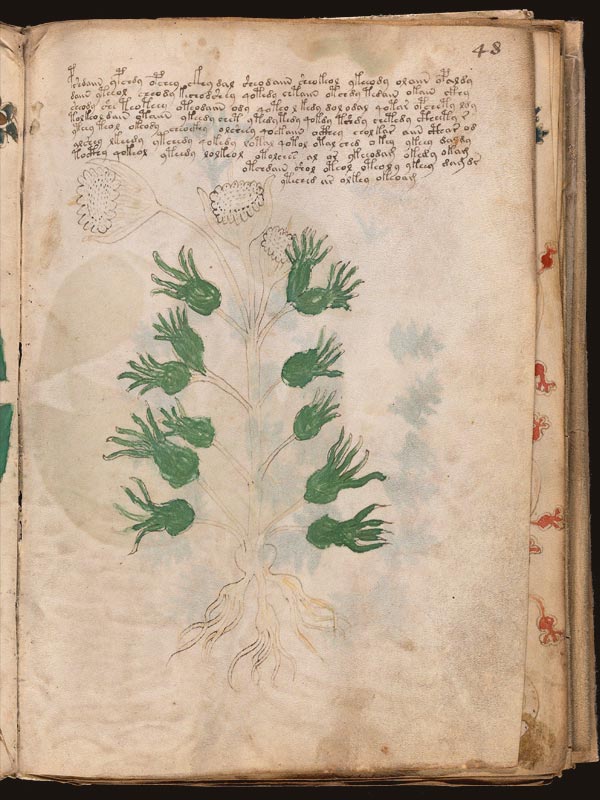
Rue (Ruta) (f48r)
For the stings of scorpions, the use of clay poultices is recommended together with preparations of pure honey, which acts gently and swiftly when applied properly and in suitable portions, especially when no other remedy is available. Preparations derived from the bee are likewise useful both for stings and for severe contusions, as they help reduce swelling and relieve pain; when applied with oil through friction, they notably improve the condition.
Natural honey proves particularly beneficial for those suffering from stings, since the virtue of the remedy lies chiefly in soothing inflammation rather than in destroying the venom itself. The preparation may be taken mixed with honey, employing an appropriate herb which, when combined with floral substances, contributes to neutralizing their harmful effects. According to the nature of the plant, maceration and grinding should be carried out, thus producing a preparation which, when used in moderation, may act as a gentle purgative without causing harm and promote healing through washings and auxiliary care.
External application is made with rue, mixed with gum or resin to improve adherence. It should be applied gently, taking into account the state and maturation of the skin lesion, using poultices that remain fixed upon the affected area. This remedy benefits various ailments and may also aid the stomach, relieving discomfort without increasing inflammation. It may likewise be applied by rubbing with vegetal matter, as grinding and pounding are simple and effective methods of preparation.
In the treatment of stings, compounds derived from the bee should be used externally and not ingested. Certain flowers possess poisonous properties of strong action, yet the proper corrective acts as an effective antidote. When the lesion develops into a persistent ulcer, cauterization may be employed as a final remedy. The preparation, when applied adherently, also serves against parasitic conditions such as lice, and the complete poultice is useful for inflammations of the glands. Finally, the plant, well crushed and applied in a closed manner upon the injured part, helps relieve stings and lessen suffering.
[Complete translation]
The plant illustrations in this manuscript do not necessarily represent the exact morphology of the identified species, but rather highlight the parts of medicinal interest and their therapeutic uses. The shapes and arrangements are stylized conventions typical of medieval manuscript tradition.
The translation presented here, with the scope indicated on the homepage, is a derivative work protected by copyright. If you use this material, you must cite the translator (Enrique Menéndez Crespo, 2025) and the original source: https://www.voynichdoc.com