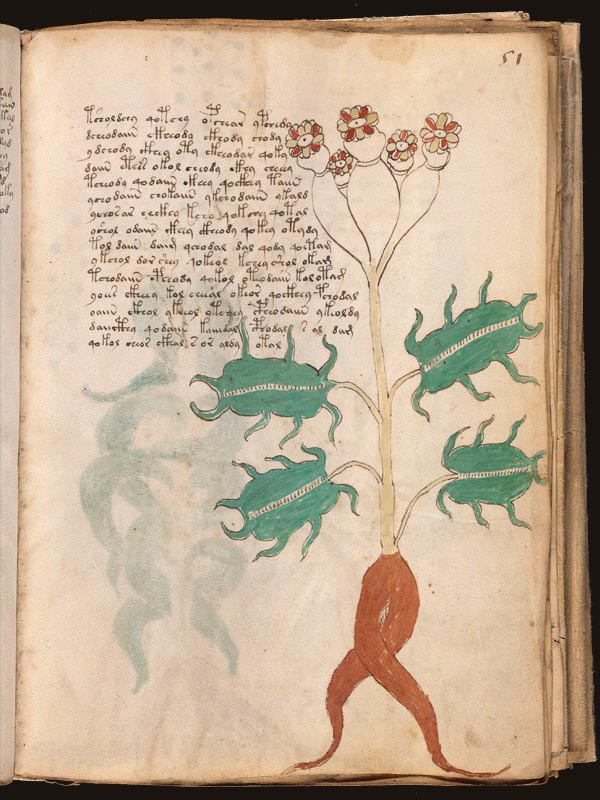
Quercus (astringent medicinal plant group including galls) (f51r)
Of the maceration and the juice drawn from the root. These herbs are of a cold complexion in a high degree and possess an aperitive virtue, whereby they open obstructions. In cases of putrefaction or corruption of humours, they are applied with friction to the region of the liver, using compresses and gentle unctions; and though some local swelling may arise, with the addition of fat they help to bring apostemes and boils to maturation. The fruit is used in powder, and likewise other parts are prepared by rubbing with galls and fine grinding.
The root is bruised and mingled with boiled milk until it be brought to a convenient form, care being taken not to exceed in grinding; and if its strength be overgreat, it is corrected with clove. Being taken in due order, this remedy comforteth the body and preserveth health. Applied outwardly in the form of a plaster or dressing, it profiteth in sores and tumours, for it hath an astringent and drying virtue, repressing suppuration and assuaging inflammation; which agreeth with the properties of oak galls.
The fruitful parts are wholesome, and the root, taken in maceration as a drink, serveth also as nourishment when mixed with honey, being of easy digestion and profitable in sundry treatments. The residue of the preparation is used with good effect upon apostemes, boils, and other suppurations in their beginning. In corrupt sores and suppurating tissues, the root is applied as a plaster, and even being calcined is used with pressure or friction for greater efficacy.
This remedy availeth against the flux of the belly and easeth pains; it openeth obstructions, even those of the blood, and by its quality and taste helpeth to expel noxious matters. For the affections of the mouth and throat it is used as an unguent, prepared with honey and applied warm, whereby it healeth sores and contusions of those parts. It is also made into a mass with some convenient substance, as bran, and applied to boils, being fit for use both inwardly and outwardly. Finally, being taken inwardly, it profiteth against the colic; and used as a rinse, it cleanseth and healeth the mouth.
[Complete translation]
The plant illustrations in this manuscript do not necessarily represent the exact morphology of the identified species, but rather highlight the parts of medicinal interest and their therapeutic uses. The shapes and arrangements are stylized conventions typical of medieval manuscript tradition.
The translation presented here, with the scope indicated on the homepage, is a derivative work protected by copyright. If you use this material, you must cite the translator (Enrique Menéndez Crespo, 2025) and the original source: https://www.voynichdoc.com