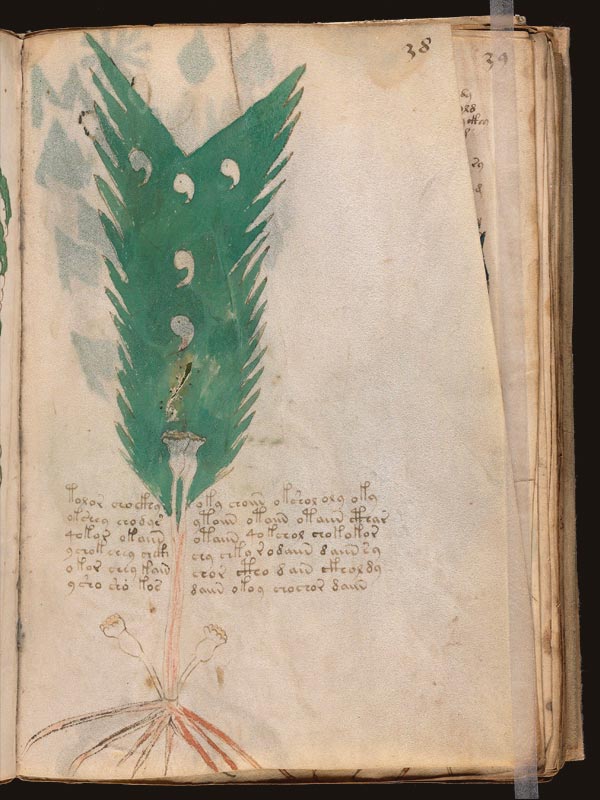
Dracunculus (Dracunculus vulgaris) (f38r)
The draconia bears a fleshy nodule approximately the size of a fist. Its stem is whitish, resembling lime, and the spathe, shaped like a funnel, appears well developed and prominent. The roots, which branch into several parts, possess an aromatic and fragrant taste comparable to that of a reed bed. As for its medicinal use, the preparation of the plant is taken and applied after it has been carefully crushed by hand. From the roots of the draconia an ointment is made, which is used as a poultice for various ailments. For this purpose the sap of the plant is employed; it is first softened, then mixed and left to macerate. The root gives off a strong odor; once crushed, the preparation is kneaded with milk and allowed to rest until it thickens, after which it is mixed and immersed as required. Finally, the resulting pulp is thickened, separated, crushed, and pressed, being mixed with gum to complete the medicinal preparation.
[Complete translation]
The plant illustrations in this manuscript do not necessarily represent the exact morphology of the identified species, but rather highlight the parts of medicinal interest and their therapeutic uses. The shapes and arrangements are stylized conventions typical of medieval manuscript tradition.
The translation presented here, with the scope indicated on the homepage, is a derivative work protected by copyright. If you use this material, you must cite the translator (Enrique Menéndez Crespo, 2025) and the original source: https://www.voynichdoc.com