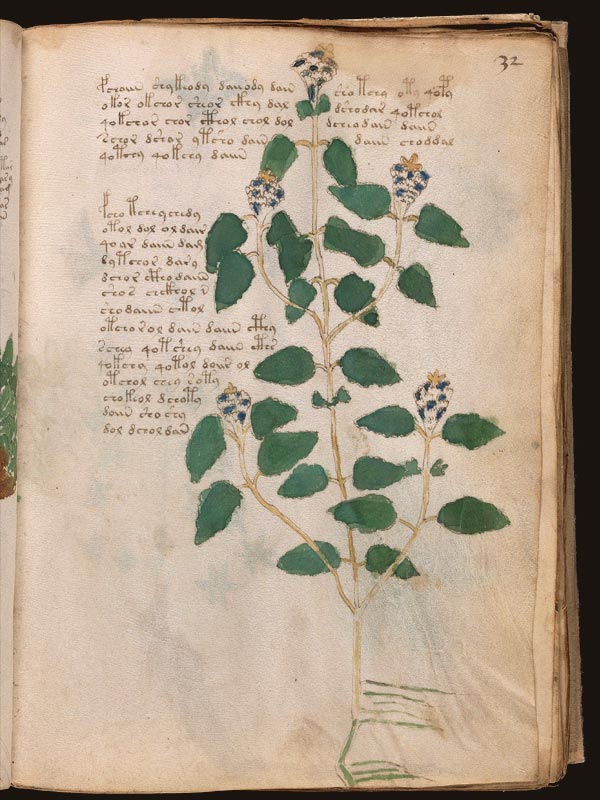
Chicory (Cichorium intybus)(f32r)
From dried chicory the leaves are taken, being either crushed or well pounded, and are added to the decoction together with resins and gum; from this there is prepared a medicinal paste which is used for cataplasms or plasters to relieve the inflammations and sores that arise in the teeth. This remedy softens the tissues, and by its application the ailment is lessened. It is prepared by boiling and applied upon the afflicted part in the manner of a bandage or plaster, together with some emollient substance. It is likewise profitable for the afflictions of the teeth and the gums, being employed with honey and with galls of an astringent virtue. The preparation is made by boiling and applied to swellings or nodules, being mixed with oak galls.
For pain the substance is applied after being pounded and reduced to powder. The roots are bruised with costus and with other herbs to cleanse and strengthen the gums. The cavity of the tooth is treated with honey and with crushed bark. For ulcers this preparation is applied as an ointment, and it may also be chewed, whereby the cavity of the mouth is opened and cleansed against the lesion. It is also useful to chew the milky and astringent juice of the root. Applied as an ointment together with this preparation it causes no harm and relieves the affection. For the tooth that is infected or corrupted, this boiled preparation serves against abscess and caries accompanied by pus. A remedy is likewise prepared with cumin and with the leaves and flowering tops of the plant, which is applied by rubbing. The more mature part is prepared only from the flowering tops, without boiling, and from them is also made a fine mixture with costus and honey to fill the cavity of the tooth.
[Complete translation]
The plant illustrations in this manuscript do not necessarily represent the exact morphology of the identified species, but rather highlight the parts of medicinal interest and their therapeutic uses. The shapes and arrangements are stylized conventions typical of medieval manuscript tradition.
The translation presented here, with the scope indicated on the homepage, is a derivative work protected by copyright. If you use this material, you must cite the translator (Enrique Menéndez Crespo, 2025) and the original source: https://www.voynichdoc.com